
Digger70pa
Well-known member
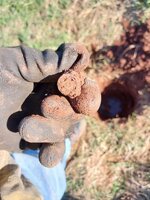
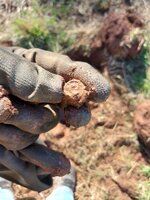
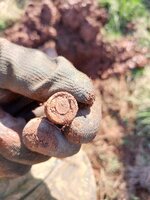
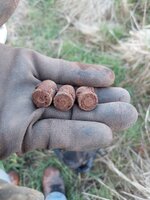
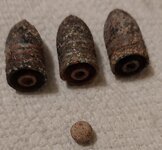
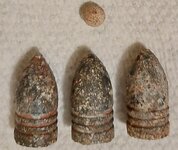
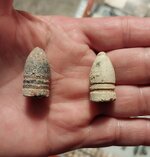
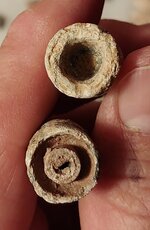
I got out Sunday & did some relic hunting after work. Im glad I did. I found a few rare Gardiner explosive bullets. These are Gettysburg campaign.
You are viewing this forums as a guest which limits you to read only status.
Only registered members may post stories, questions, classifieds, reply to other posts, contact other members using built in messaging and use many other features found on these forums.
Why not register and join us today? It's free! (We don't share your email addresses with anyone.) We keep email addresses of our users to protect them and others from bad people posting things they shouldn't.
Thank you. Its almost over here. The vegetation is growing fast. We might have a couple more weeks til everything is too high.Atta a boy Tim! Hope your weather is good we are starting to get pretty dry here,

Nice Confederate lead! They were used in the 1862 Peninsula Campaign also. Good luck hunting.I got out Sunday & did some relic hunting after work. Im glad I did. I found a few rare Gardiner explosive bullets. These are Gettysburg campaign.

I really doubt it buddy. They were submersed in ground water. When black powder gets wet it becomes inert. I would guess a preserved one could possibly go off.That is so Cool.
Can they still blow up ?
Hi buddy they are Federal bullets. They're Gardiner explosive bullets. The Confederates had a Gardner pat bullet. The Gardiner explosive bullet is on the left. The Confederate Gardner is on the right.Nice Confederate lead! They were used in the 1862 Peninsula Campaign also. Good luck hunting.
HmmmI really doubt it buddy. They were submersed in ground water. When black powder gets wet it becomes inert. I would guess a preserved one could possibly go off.
Thanks buddyGreat finds and Saves. Well Done.
Hmmm
From what I know of black powder.
When it gets wet/soaked.
First it turns into a mush.
Then as it drys out.
It turns into a cake. Hard rock.
If the saltpeter/potassium nitrate does not leach out.
It's burn rate will be drastically changed.
Though it will still burn and possibly explode depending on its confinement.
If I'm not mistaken.
This is the reason people have died drilling into civil war shells trying to make them inert.
Thinking the powder had gotten wet.
Black powder is actually made wet in the mixing grinding process in its manufacturing process.
Then when it partially wet.
A specific moisture content.
It pressed through sieve's for grain size.
Then coated with graphite and tumbled in a sweety barrel.
Soo
If the nitrate did not leach out.
The old powder could still ignite.
Throw one in a fire.
May just go off like a fuse.
Though I wouldn't stand to close.


Nice job.I learned that black powder certainly does harden and cake over time. Back in the 80's I found my only full artillery shell, a Confetrit' 12 pounder. I was so glad to find that when I pulled the shell from the ground I found the fuse to be missing. I brought the shell home and soaked the shell in a bucket of water for a few days. I Then boiled water and poured it into the cavity of the shell, agitating the inner cavity of the shell with a wooden probe. I did this several days off and on. Everytime I would do this, the black residue would pour from the shell and the smell of black powder was still present. I did this until I was satisfied that all the black powder had been removed from the shells chamber. I Then spray painted the shell. Flash forward about 20 years. I had seen a product called Gemplers. This product treats iron from the inside out and gave the iron a nice looking finish. I never was 100% satisfied with the finish on my shell so I thought I'd give this product a try. I first tried it on some of my shell frags to test it out so to speak. I was careful and I pressure washed all the paint off the shells surface. I knew that there was no powder left in the chamber of the shell, but I thought I'd check to make sure before I treated the iron. Long story short, I went through the process of boiling water, and so on. There was still some powder left after going through process some 20 years earlier. There was about a small medicine vile of powder that was still in the shell. I was amazed that there would be anything left, but there was.