Find's Treasure Forums
Welcome to Find's Treasure Forums, Guests!
You are viewing this forums as a guest which limits you to read only status.
Only registered members may post stories, questions, classifieds, reply to other posts, contact other members using built in messaging and use many other features found on these forums.
Why not register and join us today? It's free! (We don't share your email addresses with anyone.) We keep email addresses of our users to protect them and others from bad people posting things they shouldn't.
Click here to register!
Need Support Help?
Cannot log in?, click here to have new password emailed to you
You are using an out of date browser. It may not display this or other websites correctly.
You should upgrade or use an alternative browser.
You should upgrade or use an alternative browser.
Tesoro Golden uMax Discrimination-Notch Setting Study
- Thread starter Bleaver
- Start date
Critterhunter
New member
Tabman, give me a few days to get a foil top off a drink. I'll note the brand of drink it came from so you can contrast to be sure it's the same level of conductivity so judge scaling by. From *memory* I think foil caps read around 96 VDI on my machine *IF* I remember right. They give a very low foil tone. Foil starts at around the 70's or so (tiny foil and such). Maybe around 73 to 76 or so if memory serves. But I'd rather quantify it for you with an exact # you can scale to your machine with an identical low reading foil top by way of where to set your notch or disc, or via math re-adjust my number ranges to yours to scale the zones properly. I think the lowest ring # is around 74 to 76 or so in our chart (refer to the link above to find out for sure).
I might head up to the store today and if I do I'll pick up something that has a foil top, like a small orange juice or something. Anybody know which drinks have those? I think those little plastic orange drinks from Sunkist or something have them on them? I could use a milk dug's but the milk I buy doesn't have a foil cap. I want to use a smaller one to contrast for you. Something right around the lowest/thinnest/plainest women's gold ring lowest VDI # were graphed in our study, as there are bigger foil tops on some drinks. Once we have a reference point, you should be able to set your disc or notch or rescale your VDI from that base low VDI # up to say my highest tab # 99% of the time (VDI # 169), and then you can adjust your machine's discrimination/notch range or VDI reference points to something similar. Sound good? For reference too, 99.9% of all round or square tabs read on a 20 digit scale of 149 to 169 on my machine. Some zincs read 173 and others 176. Nickels are usually 144 to 146, but can read down to around 136 or so if they'd degraded badly in the ground.
I might head up to the store today and if I do I'll pick up something that has a foil top, like a small orange juice or something. Anybody know which drinks have those? I think those little plastic orange drinks from Sunkist or something have them on them? I could use a milk dug's but the milk I buy doesn't have a foil cap. I want to use a smaller one to contrast for you. Something right around the lowest/thinnest/plainest women's gold ring lowest VDI # were graphed in our study, as there are bigger foil tops on some drinks. Once we have a reference point, you should be able to set your disc or notch or rescale your VDI from that base low VDI # up to say my highest tab # 99% of the time (VDI # 169), and then you can adjust your machine's discrimination/notch range or VDI reference points to something similar. Sound good? For reference too, 99.9% of all round or square tabs read on a 20 digit scale of 149 to 169 on my machine. Some zincs read 173 and others 176. Nickels are usually 144 to 146, but can read down to around 136 or so if they'd degraded badly in the ground.
Critterhunter
New member
Bleaver, sounds like you used a good random test pool then by using that PI and also I'd assume scooping all signals above iron with the Fisher. Once again, love reading this kind of study stuff so want to say great job on the research you did. Right up my alley in what I find interesting. Have you graphed your rings via VDI to show percentages for certain zones? Meaning, foil, nickle,t ab, and zinc to upper coin range? That sort of numbers I'd love to look over to see what gives on it, just to see if the laws of probability have our numbers somewhat jiving with each other. If you do, shoot me a PM with a link so I don't miss it, as I don't always lurk in certain forums.
As many as I have dug around sports fields, I haven't a clue what they come off of. Maybe Gator Aid 
Does anyone know what these thin foil caps come off of? They have 3 small tabs evenly spaced around the edge, white on one side and silver on the other.
They measure around 1 1/2 inches across.
tabman
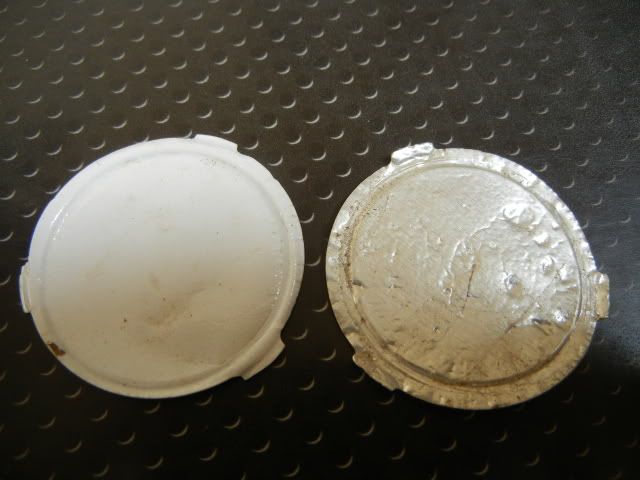
Does anyone know what these thin foil caps come off of? They have 3 small tabs evenly spaced around the edge, white on one side and silver on the other.
They measure around 1 1/2 inches across.
tabman
Having used a bunch of detectors and currently swing the Golden almost exclusively (through my Compadre still makes a regular appearance), here is one hard truth I've learned:
If you discriminate anything out above iron, you run the risk of losing gold. It's just that simple.
I guess in the end it all boils down to how much junk you're willing to dig.
Sure, you can discriminate out no trash and get most gold, some trash and still get some gold, or all trash and very little gold.
The day someone makes a detector that can change that, they will become a very rich person.
If you discriminate anything out above iron, you run the risk of losing gold. It's just that simple.
I guess in the end it all boils down to how much junk you're willing to dig.
Sure, you can discriminate out no trash and get most gold, some trash and still get some gold, or all trash and very little gold.
The day someone makes a detector that can change that, they will become a very rich person.
CladDog said:The Ace 150, 250, 350, & AT Pro from Garrett all have notching ability, as do most detectors with a TID screen.
Check with most manfacturers you like and I'm sure you'll find at least one.
Yeah, but they're not adjustable notching. Also you can change the tone break point on the Golden.
I can adjust foil sports drink caps into and out of the iron tone from the nickel tone.
tabman
Critterhunter: "sounds like you used a good random test pool then by using that PI and also I'd assume scooping all signals above iron with the Fisher." Yes, the pool is random. The Fisher CZ20/21's everything above Iron dug. In a couple of cases even Iron dug. I have run across a couple of water sites where gold and ever coins sometimes sounded in the iron range.
"Have you graphed your rings via VDI to show percentages for certain zones" That I haven't done. Until last Thursday I hadn't owned a detector with visual representations for a couple years. Now I have my first Minelab, Explorer 2, and that will take me a bit of time to learn.
tabman: "concerning the foil drink caps". All I can say is on my Golden they give a loud what I call "fart" sound. It may be my imagination but I picture a woopie cushion being suddenly deflated. Its a distinctive sound and so far I have always been correct in interpretation.
I would like to restate; I conducted this study because I was interested in getting an idea of what types of percentages of gold items the Golden uMax might detect using it in the setting configurations it was designed to, at least what I think it was designed to. While this is certainly not a definitive study, I think it shows this machine IS capable of locating coins including nickles, more than a majority of gold, while at the same time eliminating the majority of trash. That
"Have you graphed your rings via VDI to show percentages for certain zones" That I haven't done. Until last Thursday I hadn't owned a detector with visual representations for a couple years. Now I have my first Minelab, Explorer 2, and that will take me a bit of time to learn.
tabman: "concerning the foil drink caps". All I can say is on my Golden they give a loud what I call "fart" sound. It may be my imagination but I picture a woopie cushion being suddenly deflated. Its a distinctive sound and so far I have always been correct in interpretation.
I would like to restate; I conducted this study because I was interested in getting an idea of what types of percentages of gold items the Golden uMax might detect using it in the setting configurations it was designed to, at least what I think it was designed to. While this is certainly not a definitive study, I think it shows this machine IS capable of locating coins including nickles, more than a majority of gold, while at the same time eliminating the majority of trash. That
Critterhunter
New member
Thanks for the info. If you do graph the rings via a VDI, please shoot me a PM with the thread link so I don't miss it.
We graphed our same test pool of rings on an Etrac and a MTX/M6 (links to which can be found in the prior link I posted), just like we did on a Sovereign GT.
The higher the VDI resolution in the foil to say copper penny range, the more distinctions can be made of the "true" nickel, tab, and foil zones, just see if any kind of pattern exists or just where the majority of rings fall percentage wise. From memory, I think about fully half of the rings read below nickel in the foil range, and no more in greater numbers were found in the nickel or tab range and were spread pretty evenly from nickel all the way up into the coin zone for the most part, with perhaps a higher percentage of that span in the nickel to zinc penny range.
As would be expected, because gold is a lower conductor. It takes size and/or what other metals are mixed with the gold (say copper or silver maybe?) to raise their conductivity higher. And conversely, white gold I believe looks that way because it's mixed with nickel often, and so will drag a ring of similar size and shape to a yellow gold ring down a goot bit in VDI.
The GT has super high resolution in the foil to copper penney range, with much of foil spanning around 74 or 76 up to around 140 or so, while nickels tend to span from about 142 to 146 (although some bad old ones will range down to perhaps as low as 136 in VDI). Both round and square tabs, even missing tails or bent or crushed to a large extent even, tend to range in the 149 to 169 VDI range. Zincs are 173 or 176, so there is a small gap between 99% of all the highest tab readings and zincs, that I just love to dig because targets tend to be scarce in that tiny gap VDI span, and often I come up with some cool relics or other interesting finds when I see a 170, 171, or 172 VDI #. One such example that comes to mind is a antique cosmetic compact. Another more recent item was an old button.
Once again, great study, and please shoot me a PM if you do graph conductivity zones to judge any kind of percentages for rings that fall within those. I'm real curious to see if the laws of probability make our numbers jive somewhat closey. The law of averages say they probably will I would think...
We graphed our same test pool of rings on an Etrac and a MTX/M6 (links to which can be found in the prior link I posted), just like we did on a Sovereign GT.
The higher the VDI resolution in the foil to say copper penny range, the more distinctions can be made of the "true" nickel, tab, and foil zones, just see if any kind of pattern exists or just where the majority of rings fall percentage wise. From memory, I think about fully half of the rings read below nickel in the foil range, and no more in greater numbers were found in the nickel or tab range and were spread pretty evenly from nickel all the way up into the coin zone for the most part, with perhaps a higher percentage of that span in the nickel to zinc penny range.
As would be expected, because gold is a lower conductor. It takes size and/or what other metals are mixed with the gold (say copper or silver maybe?) to raise their conductivity higher. And conversely, white gold I believe looks that way because it's mixed with nickel often, and so will drag a ring of similar size and shape to a yellow gold ring down a goot bit in VDI.
The GT has super high resolution in the foil to copper penney range, with much of foil spanning around 74 or 76 up to around 140 or so, while nickels tend to span from about 142 to 146 (although some bad old ones will range down to perhaps as low as 136 in VDI). Both round and square tabs, even missing tails or bent or crushed to a large extent even, tend to range in the 149 to 169 VDI range. Zincs are 173 or 176, so there is a small gap between 99% of all the highest tab readings and zincs, that I just love to dig because targets tend to be scarce in that tiny gap VDI span, and often I come up with some cool relics or other interesting finds when I see a 170, 171, or 172 VDI #. One such example that comes to mind is a antique cosmetic compact. Another more recent item was an old button.
Once again, great study, and please shoot me a PM if you do graph conductivity zones to judge any kind of percentages for rings that fall within those. I'm real curious to see if the laws of probability make our numbers jive somewhat closey. The law of averages say they probably will I would think...
Critterhunter
New member
Tabman, today I was at the local gas station and decided to see if I could buy a small drink with a foil type, that way you could buy the same drink and then have an exact matching foil # to re-scale your machine's VDI to match the 100+ ring graphing we did. Well, I couldn't remember which drinks have the foil on them, wanting to use a small drink so the foil is not too large, resulting in a higher VDI for your base line. I asked the clerk if she knew of any, and she said she thought a certain chocolate milk in a aluminum bottle had one under the cap. Bought the drink but no dice. Oh well, I had a taste for some chocolate milk anyway. 
So what I need you to do, is to buy a small drink (IE: not a large mouth on it) and then tell me which brand drink you have and what size (probably 12 or 16 ounces) and I'll buy the same one to match up. I'm interested anyway to see if my recollection of those foil tops read around 68 or so in VDI. I know it's a very low foil tone, probably at the very bottom of foil, and if memory serves (refer to prior link for the ring graphing we did), I think the smallest/thinnest/plainest of a woman's band starts at about 74 or 76 or so. When we get the foil tops matched up, then I'll dig up those numbers for the rings, and then we've got your base line.
I guess your whole point is to see if you can disc out those foil tops, and still find the lowest ring #? My suspicion is yes, since a intact round ring would present a more conductive target than even a foil top. I want to pin this down anyway just for my curiosity sake too, and will be added both our infos and a thread link to this thread and the one you started in the Teknetics forum as well, to my condensed splitting hairs on rings thread I prior provided a link to. All these things go hand and hand, and having a base line target to judge VDI scaling by will help others with other machines to re-scale all the ring numbers to apply to their machines, so I'm glad you are dabbling with these things here...
Good read and interesting info, even if strategies might not be as sound as we might think. But all about playing the odds to me, by using various strategies, to eliminate numerous junk looking for gold rings, by concentrating on other zones of conductivity that a particular site seems to lack much of in way of trash. By doing so, you are lowering your potential trash to treasure ratio, making the effort more worth it in certain land hunting situations.
So what I need you to do, is to buy a small drink (IE: not a large mouth on it) and then tell me which brand drink you have and what size (probably 12 or 16 ounces) and I'll buy the same one to match up. I'm interested anyway to see if my recollection of those foil tops read around 68 or so in VDI. I know it's a very low foil tone, probably at the very bottom of foil, and if memory serves (refer to prior link for the ring graphing we did), I think the smallest/thinnest/plainest of a woman's band starts at about 74 or 76 or so. When we get the foil tops matched up, then I'll dig up those numbers for the rings, and then we've got your base line.
I guess your whole point is to see if you can disc out those foil tops, and still find the lowest ring #? My suspicion is yes, since a intact round ring would present a more conductive target than even a foil top. I want to pin this down anyway just for my curiosity sake too, and will be added both our infos and a thread link to this thread and the one you started in the Teknetics forum as well, to my condensed splitting hairs on rings thread I prior provided a link to. All these things go hand and hand, and having a base line target to judge VDI scaling by will help others with other machines to re-scale all the ring numbers to apply to their machines, so I'm glad you are dabbling with these things here...
Good read and interesting info, even if strategies might not be as sound as we might think. But all about playing the odds to me, by using various strategies, to eliminate numerous junk looking for gold rings, by concentrating on other zones of conductivity that a particular site seems to lack much of in way of trash. By doing so, you are lowering your potential trash to treasure ratio, making the effort more worth it in certain land hunting situations.
Critterhunter
New member
Hey Tabman, I scanned the two foil caps you mailed me, looking identical to these you had posted a picture of prior...
[attachment 258032 SportsDrinkCaps001_zpsba03d727.jpg]
Which I would assume perhaps came off these sport drink bottles you posted a picture of before as well in this related thread in the Teknetics forum you started here...http://www.findmall.com/read.php?58,1857526,page=1
[attachment 258036 gatoraid_zpsde09d47a.jpg]
You mentioned you are finding these foil tops as the far most numerous trash item at sports fields you hunt, so it would make perfect sense to me that the above picture you posted of a sport drink is the most common source of those foil tops you are finding. Probably other sports drinks with the same type of tops as well. I know I've seen similar ones on non-sport drinks but can't off hand place just which drinks I've bought in the past that have them.
Now we can do what you were shooting for...To know just where those foil tops read in VDI on my machine in relation to our lowest gold ring numbers in those 121 rings we graphed, and also re-scaling the Teknetics Gamma 2 metal detector's VDI to the Sovereigns 180 meter for various conductivity zones. More to the point I think of what you were asking in the first place, is if you calibrate your Tesoro's notch or disc dial to just kill those foil tops, how many gold rings might that be costing you percentage wise according to our charted VDI numbers we crunched? In this thread is all the info on those 121 truly random rings used in the test pool we scanned, which also contains links to various other threads in which people have shared their methods and ideas for finding rings on land...http://www.findmall.com/read.php?21,1720979,page=1
So where do these foil tops read in comparison to our lowest gold ring VDI #s? The two foil tops you sent me of the type you posted pictures of prior, you had marked as both reading #48 on your G2 using the 5" coil. On the Sovereign every meter has a calibration pot to set it to go 180 on a dime or quarter when you switch coils, thus all coils used, big or small, will read the same exact VDI # for anything on the scale of conductivity once calibrated properly. Does your G2 change it's VDI a bit based on coil choice?
Either way, I only wish you had marked these two foil tops #1 and #2, because while they both read 48 on your machine, the Sovereign has extremely high resolution from small foil all the way up to the copper penny range. Point being that while both of these foil tops are in good shape and appear to be from the same manufacturer (?), they both have slightly different VDI #s. If they had been marked #1 and 2 I could have noted which read what and then mailed them back to you, so that you could get even finer hair line adjustment on your discrimination or notch dials (whichever you are using on the Tesoro). Regardless, they are so close in VDI that that probably won't matter much. So here are the results...
Both foil tops for you read 48, while for me using a 180 scale meter on my Sovereign, one foil top scans in as a VDI # of either 86 or 87, while the other scans in as a VDI # of 89 or 90. I repeated this test numerous times on both, sweeping from several angles, and allowing my machine to "warm" up about 5 minutes to be sure the meter's calibration pot was set precisely to go 180 on a dime, so that the resulting #s would be as precise as possible.
Now we get to where the rubber meets the road for you...So, refreshing our memory on where the smallest/thinnest/plainest of over 121 gold rings read, meaning what was the very lowest VDI #s we scanned with all those rings, the lowest # being that of...75. Here, I'll repost the chart for you to look over from the prior "A condensed splitting hairs on rings thread" link I posted where we crunched all these numbers...
[attachment 258031 SovereignGTGoldRingChartJPEG.jpg]
If you just high ball it to the highest of the two foil top numbers I got from the two, that would be 90 in VDI. OK then, so if you raise discrimination high enough to just barely knock out that foil top, exactly how many of the 121 gold *truly random* gold rings will you be missing? The grand total would be 9 of them, and note that all those 9 are small gold rings, and further still yet 4 of those 9 are white gold, which tend to read very low in VDI due to the materials usually mixed with them to give them their color (IE: Probably nickel as one possibility, which will drag the VDI # down).
Also, notice that white gold rings are far less common than yellow gold, and that all 4 of the white gold rings classified as "small" in are chart that will be missed are the entire sampled small white gold rings we charted. If somebody has you looking for a small white gold ring for sure you would not want to disc out the foil tops to try to find it. But, when just huntiong for rings on land, if you look at the chart as a whole, white gold, and in particular small white gold, isn't very common, so by discing out the foil types you are leaving behind a far lower percentage of possible rings (by our numbers if not anybody else's of course).
So there you have it...Not only can you re-scale our VDI scaling to your G2 of various zones, but you can also now calibrate your Tesoro's notch or disc to various zone cut off points as well. To see where your nickel zone begins versus mine, scan a modern nickel. On my machine it's typical nickels read right around 143 to 146 in VDI (most perhaps in the 144 to 146 range). 99% of all tabs I come across, both round and square, read from 149 to 169 in VDI range. Copper pennies such as wheats will usually read 178 or 180. Zincs for me usually 173 or 176. All coins above a copper penny in conductivity read 180. That may sound like a drawback but when I'm old coin hunting I don't care what kind of coin the machine thinks it is, as I've dug plenty of silvers in the past that read as clads or pennies on machines I've own that could split hairs on coin types. If it's deep I just want to know it's a coin, or if it's shallow but mixed in trash same deal, because somebody might have missed a shallow oldie. Dry conditions, minerals, being on edge, masking, the coin being worn badly...All these things I've seen cause silvers to read as some other coin in the past.
Now you just have to decide- Is giving up those potential 9 rings worth raising discrimination to just barely kill a foil drink top? Depends on the amount of trash at that VDI and lower in conductivity. If it's there by the thousands then yea I'd ignore anything lower myself. All a matter of productive use of time while trying to swing odds in your favor, as to which zones I might ignore and which I might dig, all depending on how much of what kind of trash is present in those given conductivity zones. IE: Digging 10 thousand tabs just to recover a small percentage of rings you'd might miss otherwise to me (on land that is) is not worth my time most days. Instead I'll ignore those and dig all else.
Or, if there is a ton of foil or other low conductors but not much in way of tabs, or say only a few specific tab #s that keep showing up, then I'll dig the tab range and all others and avoid the foil below nickel (say 140 VDI or lower) and dig everything above that, perhaps avoiding one or two pesky tab #s that seem most present at the given site. Same deal with zincs. If there are billions I'll avoid those when ring or say old coin hunting, willing to give up a possible ring or two or the odd old coin that reads as a zinc. All a matter of trying to slant the odds in my favor to decrease the ration of treasure dug versus trash. Also all depends on my mood. Some days I'll pick a small area and grid it out and dig all signals above iron.
[attachment 258032 SportsDrinkCaps001_zpsba03d727.jpg]
Which I would assume perhaps came off these sport drink bottles you posted a picture of before as well in this related thread in the Teknetics forum you started here...http://www.findmall.com/read.php?58,1857526,page=1
[attachment 258036 gatoraid_zpsde09d47a.jpg]
You mentioned you are finding these foil tops as the far most numerous trash item at sports fields you hunt, so it would make perfect sense to me that the above picture you posted of a sport drink is the most common source of those foil tops you are finding. Probably other sports drinks with the same type of tops as well. I know I've seen similar ones on non-sport drinks but can't off hand place just which drinks I've bought in the past that have them.
Now we can do what you were shooting for...To know just where those foil tops read in VDI on my machine in relation to our lowest gold ring numbers in those 121 rings we graphed, and also re-scaling the Teknetics Gamma 2 metal detector's VDI to the Sovereigns 180 meter for various conductivity zones. More to the point I think of what you were asking in the first place, is if you calibrate your Tesoro's notch or disc dial to just kill those foil tops, how many gold rings might that be costing you percentage wise according to our charted VDI numbers we crunched? In this thread is all the info on those 121 truly random rings used in the test pool we scanned, which also contains links to various other threads in which people have shared their methods and ideas for finding rings on land...http://www.findmall.com/read.php?21,1720979,page=1
So where do these foil tops read in comparison to our lowest gold ring VDI #s? The two foil tops you sent me of the type you posted pictures of prior, you had marked as both reading #48 on your G2 using the 5" coil. On the Sovereign every meter has a calibration pot to set it to go 180 on a dime or quarter when you switch coils, thus all coils used, big or small, will read the same exact VDI # for anything on the scale of conductivity once calibrated properly. Does your G2 change it's VDI a bit based on coil choice?
Either way, I only wish you had marked these two foil tops #1 and #2, because while they both read 48 on your machine, the Sovereign has extremely high resolution from small foil all the way up to the copper penny range. Point being that while both of these foil tops are in good shape and appear to be from the same manufacturer (?), they both have slightly different VDI #s. If they had been marked #1 and 2 I could have noted which read what and then mailed them back to you, so that you could get even finer hair line adjustment on your discrimination or notch dials (whichever you are using on the Tesoro). Regardless, they are so close in VDI that that probably won't matter much. So here are the results...
Both foil tops for you read 48, while for me using a 180 scale meter on my Sovereign, one foil top scans in as a VDI # of either 86 or 87, while the other scans in as a VDI # of 89 or 90. I repeated this test numerous times on both, sweeping from several angles, and allowing my machine to "warm" up about 5 minutes to be sure the meter's calibration pot was set precisely to go 180 on a dime, so that the resulting #s would be as precise as possible.
Now we get to where the rubber meets the road for you...So, refreshing our memory on where the smallest/thinnest/plainest of over 121 gold rings read, meaning what was the very lowest VDI #s we scanned with all those rings, the lowest # being that of...75. Here, I'll repost the chart for you to look over from the prior "A condensed splitting hairs on rings thread" link I posted where we crunched all these numbers...
[attachment 258031 SovereignGTGoldRingChartJPEG.jpg]
If you just high ball it to the highest of the two foil top numbers I got from the two, that would be 90 in VDI. OK then, so if you raise discrimination high enough to just barely knock out that foil top, exactly how many of the 121 gold *truly random* gold rings will you be missing? The grand total would be 9 of them, and note that all those 9 are small gold rings, and further still yet 4 of those 9 are white gold, which tend to read very low in VDI due to the materials usually mixed with them to give them their color (IE: Probably nickel as one possibility, which will drag the VDI # down).
Also, notice that white gold rings are far less common than yellow gold, and that all 4 of the white gold rings classified as "small" in are chart that will be missed are the entire sampled small white gold rings we charted. If somebody has you looking for a small white gold ring for sure you would not want to disc out the foil tops to try to find it. But, when just huntiong for rings on land, if you look at the chart as a whole, white gold, and in particular small white gold, isn't very common, so by discing out the foil types you are leaving behind a far lower percentage of possible rings (by our numbers if not anybody else's of course).
So there you have it...Not only can you re-scale our VDI scaling to your G2 of various zones, but you can also now calibrate your Tesoro's notch or disc to various zone cut off points as well. To see where your nickel zone begins versus mine, scan a modern nickel. On my machine it's typical nickels read right around 143 to 146 in VDI (most perhaps in the 144 to 146 range). 99% of all tabs I come across, both round and square, read from 149 to 169 in VDI range. Copper pennies such as wheats will usually read 178 or 180. Zincs for me usually 173 or 176. All coins above a copper penny in conductivity read 180. That may sound like a drawback but when I'm old coin hunting I don't care what kind of coin the machine thinks it is, as I've dug plenty of silvers in the past that read as clads or pennies on machines I've own that could split hairs on coin types. If it's deep I just want to know it's a coin, or if it's shallow but mixed in trash same deal, because somebody might have missed a shallow oldie. Dry conditions, minerals, being on edge, masking, the coin being worn badly...All these things I've seen cause silvers to read as some other coin in the past.
Now you just have to decide- Is giving up those potential 9 rings worth raising discrimination to just barely kill a foil drink top? Depends on the amount of trash at that VDI and lower in conductivity. If it's there by the thousands then yea I'd ignore anything lower myself. All a matter of productive use of time while trying to swing odds in your favor, as to which zones I might ignore and which I might dig, all depending on how much of what kind of trash is present in those given conductivity zones. IE: Digging 10 thousand tabs just to recover a small percentage of rings you'd might miss otherwise to me (on land that is) is not worth my time most days. Instead I'll ignore those and dig all else.
Or, if there is a ton of foil or other low conductors but not much in way of tabs, or say only a few specific tab #s that keep showing up, then I'll dig the tab range and all others and avoid the foil below nickel (say 140 VDI or lower) and dig everything above that, perhaps avoiding one or two pesky tab #s that seem most present at the given site. Same deal with zincs. If there are billions I'll avoid those when ring or say old coin hunting, willing to give up a possible ring or two or the odd old coin that reads as a zinc. All a matter of trying to slant the odds in my favor to decrease the ration of treasure dug versus trash. Also all depends on my mood. Some days I'll pick a small area and grid it out and dig all signals above iron.
Critterhunter
New member
One more thought...Besides the 4 small white gold rings (the entire span of those we scanned in being missed- 4 rings total in the chart), what of the other 5 of those 9 rings you'll miss? Those were classified as small yellow gold. Thinking perhaps no big deal to miss small thin gold rings since they don't have much gold weight to them? Consider first that many thin gold rings are the ones with diamonds in them. IE: Woman's wedding bands, although they might be a bit bigger usually than what we charted as "small" for those particular 9 rings, or maybe with the crown on them to hold the diamond they would read higher and these above were just plain super thin bands with no tiny crown on them. Can't remember off hand.
Critterhunter
New member
More than welcome. Let me know how well notching or discing out those foil tops works for you to avoid a bunch of trash in those sports fields, and if you end up finding rings seemingly more often (meaning that your trash to treasure ratio has improved). Hey, while I'm here, might as well correct a bone headed mistake that sounds pretty stupid (not finished with my morning coffee yet... ). Didn't have time to edit and fix this paragraph...
"Either way, I only wish you had marked these two foil tops #1 and #2, because while they both read 48 on your machine, the Sovereign has extremely high resolution from small foil all the way up to the copper penny range. Point being that while both of these foil tops are in good shape and appear to be from the same manufacturer (?), they both have slightly different VDI #s. If they had been marked #1 and 2 I could have noted which read what and then mailed them back to you, so that you could get even finer hair line adjustment on your discrimination or notch dials (whichever you are using on the Tesoro). Regardless, they are so close in VDI that that probably won't matter much. So here are the results..."
Yea, kinda groggy. Obviously I could just mark them one and two myself and mail them back to use, noting which read what. What I meant to say is this in my cloudy thinking process until the caffeine kicks in...
Either way, I only wish you had marked these two foil tops #1 and #2, because while they both read 48 on your machine, the Sovereign has extremely high resolution from small foil all the way up to the copper penny range. Point being that while both of these foil tops are in good shape and appear to be from the same manufacturer (?), they both have slightly different VDI #s. If you had marked them #1 and 2 based on manufacturer I could have noted #1 or #2 so you'd know which of them read from what manufacturing source to use for even finer hair line adjustment on your discrimination or notch dials (whichever you are using on the Tesoro). Regardless, they are so close in VDI that that probably won't matter much, and by shooting for the highest VDI # I read of the two you'll insure you are missing the other lower reading one as well, along with knowing just what percentage of rings that might be costing you using the highest reading one. Just scan over several similar looking foil tops as you make your adjustments until all are silenced.
). Didn't have time to edit and fix this paragraph..."Either way, I only wish you had marked these two foil tops #1 and #2, because while they both read 48 on your machine, the Sovereign has extremely high resolution from small foil all the way up to the copper penny range. Point being that while both of these foil tops are in good shape and appear to be from the same manufacturer (?), they both have slightly different VDI #s. If they had been marked #1 and 2 I could have noted which read what and then mailed them back to you, so that you could get even finer hair line adjustment on your discrimination or notch dials (whichever you are using on the Tesoro). Regardless, they are so close in VDI that that probably won't matter much. So here are the results..."
Yea, kinda groggy. Obviously I could just mark them one and two myself and mail them back to use, noting which read what. What I meant to say is this in my cloudy thinking process until the caffeine kicks in...
Either way, I only wish you had marked these two foil tops #1 and #2, because while they both read 48 on your machine, the Sovereign has extremely high resolution from small foil all the way up to the copper penny range. Point being that while both of these foil tops are in good shape and appear to be from the same manufacturer (?), they both have slightly different VDI #s. If you had marked them #1 and 2 based on manufacturer I could have noted #1 or #2 so you'd know which of them read from what manufacturing source to use for even finer hair line adjustment on your discrimination or notch dials (whichever you are using on the Tesoro). Regardless, they are so close in VDI that that probably won't matter much, and by shooting for the highest VDI # I read of the two you'll insure you are missing the other lower reading one as well, along with knowing just what percentage of rings that might be costing you using the highest reading one. Just scan over several similar looking foil tops as you make your adjustments until all are silenced.

Dign-nbama
Member
Wow,, talk about giving away a bag full of tricks,, don't own one but I'm gonna,, Man,, the things you can learn on here.. "priceless"